Rasteri
A non-destructive pixel-art editor. Every pixel is derived, so every decision stays editable.
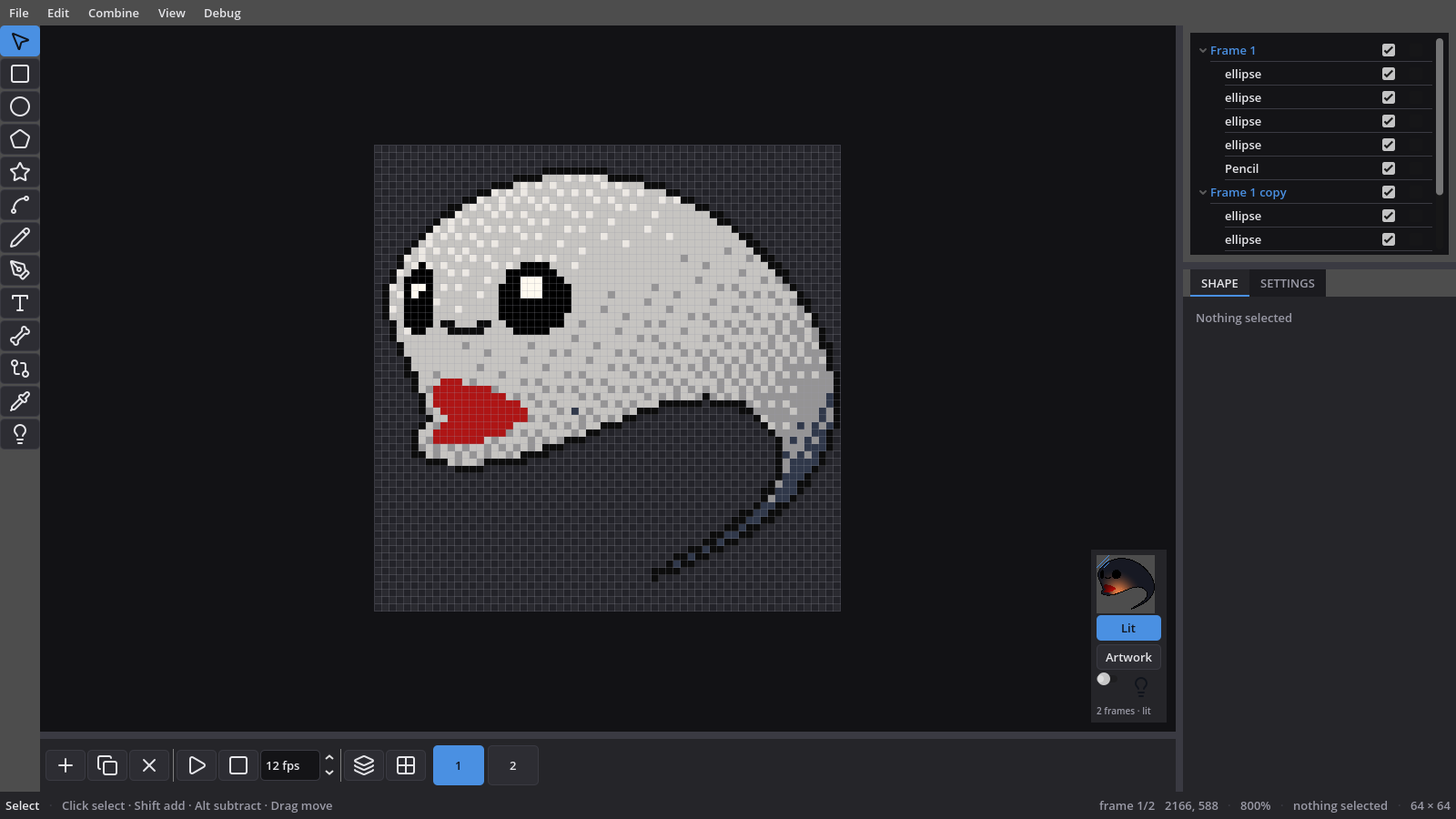
Pixel art is normally destructive. You draw it pixel by pixel, so resizing it, recolouring it or relighting it means redrawing it.
Rasteri keeps a vector document instead: shapes, bezier paths and live boolean ops, rendered through a fixed-resolution artboard. Zooming enlarges the pixels, never the artwork. Every pixel you see is derived, so every decision stays editable.
Try it in your browser. No install, no account, nothing uploaded.
Shapes have relief
Extrude, bevel, bulge and tilt, lit by real lights. Flat art shades like a shallow sculpture, and the lighting is never baked into the colours.
Exports get re-lit in the engine
Every bake ships colour, normal, height, emission, specular and AO maps, plus a ready-made Godot CanvasTexture. A PointLight2D sweeping past your sprite actually lights the relief.
How it's built
The editor started as about 30,000 lines of JavaScript on top of the three.js editor. It's now rebuilt in Godot 4 and exported to the web, so the same app runs in the browser and on the desktop.
The site at rasteri.app is a gallery as well as a home page. Each work's bake maps re-light live in the page, the same way they would in a game.
Where it's going
Uploads to the gallery are next. The pipeline is built; it isn't open to everyone yet.
React
No account needed.
Follow
Get an email when Rasteri moves.
Progress
Comments
No comments yet. Yours would be the first.